作者:
浏览量:64
日期:2025-07-21
Part Ⅰ Theory of Acupuncture and Moxibustion Meridians, Collaterals and Acupoints
Chapter 1 General Introduction of the Meridians and Collaterals
1.1 Composition of the System of the Meridians and Collaterals
1.1.1 Definition of the Meridians and Collaterals
The meridians and collaterals are the pathways through which qi and blood circulate in the human body. They connect with the zang and fu organs and link the outer with the inner portions of the body.
The meridians and collaterals are together called Jingluo in traditional Chinese medicine. “Meridians”means pathways; “collaterals” means networks. It is written in the book Yi Xue Ru Men (Rudiments of Medicine) that meridians are pathways; collaterals are branches which run crosswise from the meridians. Most meridians run deeper within the interior of the body, while collaterals travel in the shallow or even superficial part.
1.1.2 The Composition and Function of the System of Meridians and Collaterals
This system includes meridians and collaterals.
There are twelve main meridians, eight extra meridians, and a group subordinate to the twelve meridians, including twelve divergent meridians, twelve muscle regions and twelve cutaneous regions.
Collaterals include the fifteen collaterals, the tertiary collaterals and superficial collaterals.
1.1.2.1 Meridians
(1) The Twelve Main Meridians: Hand: three yin meridians, Hand: three yang meridians, Foot: three yin meridians, and Foot: three yang meridians.
They are the main pathways through which qi and blood circulate, having a connection with the zang-fu organs inside the body.
(2)The Eight Extra Meridians: significant meridians besides twelve main meridians. They are the conception vessel, the governor vessel, the thoroughfare vessel, the belt vessel, theyin heel vessel, the yang heel vessel, the yin link vessel, and the yang link vessel. They govern, connect and regulate twelve main meridians.
(3) The Twelve Divergent Meridians: branch out from the twelve main meridians. They strengthen the
interior-exterior relationship of the twelve main meridians.
1.1.2.2 Collaterals
(1) The Fifteen Main Collaterals: collateralsfrom the twelve main meridians, one each from conception and governor vessels, and the major collateral from the spleen. They strengthen the interior-exterior relationships of the twelve main meridians on the superficial parts of the body and supplement the inadequate circulation of qi and blood.
(2) Tertiary Collaterals: minute collarerals.
(3) Superficial Collaterals: collaterals running on the surface of the body.
1.1.2.3 Twelve Muscle Regions
Conduits which gather, meet, spread and join the qi of the twelve main meridians to the muscles, tendons and joints. The main functions of the muscle regions are to connect the whole body and maintain the normal locomotive functions of the joints.
1.1.2.4 Twelve Cutaneous Regions
The surface of the body reflecting the superficial functions of the twelve main meridians.
1.1.3 Circulation, Direction and Linking Law of the Twelve Main Meridians
The three yin meridians of the hand travel from the chest to the hand; the three yang meridians of the hand travel from the hand to the head.
The three yang meridians of the foot travel from the head to the foot; the three yin meridians of the foot travel from the foot to the abdomen and chest.
1.1.4 The Distribution Law of the Twelve Main Meridians
Four extremities: yin meridians: medial part of the extremities; yang meridians: lateral part of the extremities.
General character: Taiyin , Yangming → leading edge; Shaoyin , Taiyang → trailing edge; Jueyin , Shaoyang→middle.
Exception: lower part of the calf, dorsum of foot and the part below eight cun above the medial malleolus. (Foot) Jueyin→leading edge; Taiyin→middle; Shaoyin→trailing edge.
1.1.5 The Cyclical Flow of Qi and Blood in the Twelve Main Meridians
Lung meridian→ Large Intestine meridian→ Stomach meridian→ Spleen meridian→ Heart meridian→ Small Intestine meridian→ Bladder meridian→ Kidney meridian→ Pericardium meridian → Triple energizer meridian→ Gallbladder meridian→ Liver meridian→ Lung meridian
1.1.6 The Eight Extra Meridians
The governor vessel, the conception vessel, the thoroughfare vessel, the belt vessel, theyin heel vessel, the yang heel vessel, theyin link vessel, and the yang link vessel.
1.1.6.1 What Are the Characteristics of Extra Meridians?
Their courses are not as regular as the twelve main meridians. None of them have a relationship with zang-fu organs.
They are not interior-exteriorly related: for the twelve main meridians, the interior-exterior or yin-yang meridians have a connecting-pertaining relationship in the body. For example, the lung meridian of hand Taiyin pertains to the large intestine, and the large intestine meridian of hand Yangming pertains to the lung. The relationship of interior-exterior meridians is strengthened by collaterals in the four extremities. In this aspect, they are different from the twelve main meridians and therefore are called extra meridians.
1.1.6.2 The Sea of Yang Meridians, the Sea of Yin Meridians, Si Hai (four seas), and the Fourteen Meridians
The governor vessel, the conception vessel and the thoroughfare vessel all originate in the uterus and emerge from the perineum, three meridians sharing the same origin.
The governor vessel runs in the middle of the back and waist and ascends to the head. The conception vessel runs in the middle of the chest and abdomen and ascends to the neck. The thoroughfare vessel goes upward with the kidney meridian of Foot-Shaoyin and revolves around the mouth. The governor vessel is associated with six yang meridians.
The governor vessel runs in the middle of the back and crosses with six yang meridians and yang link vessel for many times. It commands all the yang meridians of the body and therefore it is called the sea of yang meridians.
The conception vessel runs in the middle of the abdomen and goes across six yin meridians for many times. It leads all theyin meridians of the body, hence the sea of yin meridians. It is associated with pregnancy, so there is the saying that conception vessel controls the birth.
The thoroughfare vessel is the communication center of qi and blood. It goes up to the head and down to the foot, combines with the conception vessel in the chest and connects with the governor vessel in the back. As the governor vessel and the conception vessel command the twelve main meridians and contain qi and blood from the twelve main meridians, the thoroughfare vessel is called the sea of the twelve main meridians and the sea of blood. Among eight extra meridians, only the governor vessel and the conception vessel have their own acupoints, which is the same with the twelve main meridians. So they are collectively called the fourteen meridians.
1.1.6.3 The Belt Vessel, the Yin Heel Vessel, the Yang Heel Vessel, the Yin Linking Vessel, and the Yang Linking Vessel
The belt vessel goes around the waist like the belt and controls lengthwise meridians.
Theyin heel vessel and the yang heel vessel nourish eyes, control the opening and closing of eyelids and the motion of lower extremities.
Theyin linking vessel and the yang linking vessel connect with allyin and yang meridians.
1.1.7 The Fifteen Main Collaterals
1.1.7.1 Composition
Collaterals from the twelve main meridians and one each from the conception and the governor vessels and the major collateral from the spleen.
1.1.7.2 Characteristics and Functions
(1) The collaterals of the twelve main meridians originate from the luo points of the meridians that are below elbows or knees, and run to the interior-exterior meridians, which strengthens the relationship of the interior- exterior meridians.
(2) The collaterals of the conception vessel originate from the Jiuwei (CV 15), spread in the abdomen and communicate with the qi of the abdomen.
(3) The collaterals of the governor vessel originate from the Changqiang (GV 1), spread in the head and communicate with the qi of the back.
(4) The major collaterals of the spleen originate from the Dabao (SP 21), spread in the chest and hypochondrium, and communicate with the qi of the side part of the chest.
1.1.8 The Twelve Divergent Meridians
1.1.8.1 The Definition of Divergent Meridians
Branches go from the twelve main meridians and run in the chest, abdomen and head.
1.1.8.2 The Characteristics of Course: Deriving, Entering, Emerging and Confluencing
They are derived from the twelve main meridians at the joints of the elbows and knees. They enter in the thoracic and abdominal cavities. Then they emerge from the body superficies at the head. The 6 yin divergent meridians converge with the 6 related internally-externally related yang meridians, so it is called as confluencing.
1.1.8.3 Clinical Significance
(1) Strengthening the connection between the twelve main meridians and the head. As yin divergent meridians converge with internally-externally related yang meridians, the connection between yin meridians and the head is strengthened. Six yin meridians do not go in the head but can be used to treat the diseases of the head and five orifices, because the divergent meridians are connected with the head and face. It is written in the Xie Qi Zang-fu Bing Xing, Ling Shu that qi and blood of the twelve main meridians and collaterals all ascend to the face and orifices.
(2) Strengthening the connection between three yin meridians of foot and three yang meridians of foot and the heart, and supplement the circulation of the twelve main meridians in the interior and exterior parts of the body. The collaterals of three yin meridians of foot and three yang meridians of foot go upward by chest and abdomen, strengthening the interior-exterior relationship of organs of abdomen cavity. They are also connected with the heart in the chest cavity, which provides basis for the theory that heart is the leader of the five zang-organs and six fu-organs.
1.1.9 The Twelve Muscle Regions
1.1.9.1 Definition
The twelve muscle regions are the conduits that join the twelve main meridians to the muscles, tendons and joints, and are peripheral connected part of the twelve main meridians. That is to say, all the muscles of the body are distributed into twelve groups according to the distribution region of the twelve main meridians, hence we call them twelve main meridians.
1.1.9.2 Characteristics of Distribution
They all originate from the ends of the extremities and ascend to the head and trunk, but travel along the body surface. They do not enter into the zang-fu organs, but meet in the joints and bones.
1.1.9.3 Functions
To control the bones, facilitate flexion and extension of the joints and to maintain the normal locomotive function of the body.
The malfunction of the joints and muscles are to some extent due to pathogenic changes of muscle regions. The symptoms of muscle regions include spasm, stiffness and convulsion.
1.1.10 The Twelve Cutaneous Regions
1.1.10.1 Definition
The part of the system of meridians and collaterals located in the superficial layers of the body. The twelve meridians and their collaterals have their distribution area in the body surface. Accordingly, the skin of the whole body is divided into twelve parts, called the twelve cutaneous regions.
1.1.10.2 Clinical Application
Due to the close connection between cutaneous regions and meridians, collaterals, zang-fu organs, a dermal needle is used to tap the skin and an intradermal needle is buried into the skin in the treatment of diseases of meridians,collaterals, and zang-fu organs.
The School of Lying Down Needles, one of the French schools of acupuncture. They puncture the shallow part of the skin with favorable effects, following the theory of the cutaneous regions.
1.1.11 Physiological Functions of the Meridians and Collaterals
It is written in Ling Shu · Jing Bie that the twelve main meridians are what keep humans alive, making diseases occur. They treat patients and relieve symptoms. They are where learning starts and skill ends. That is to say, the generation of the human body is closely related to the meridians. The development of diseases is related to the meridians.
Doctors treat diseases according to meridians. The relief of diseases begins with meridians. Students learn meridians from the beginning of their studies and the excellence of doctors can be shown by their application of theory of meridians. As a result, it is written in Ling Shu ·Jing Mai that the meridians can decide death and life, deal with various diseases, regulate deficiency and exuberance, and cannot be without effectiveness.
The meridians connect with the zang-fu organs, the extremities and trunk (and integrate the body into an organic whole). They transport qi and blood and nourish the whole body to harmonize yin and yang; to resist exopathogens and protect the body.
1.1.12 Application of the Theory of the Meridians and Collaterals
1.1.12.1 Explaining Pathogenic Changes
Under normal physiological conditions, meridians and collaterals have the function of transporting qi and blood, induction and conduction. However, in the case of diseases, they turn into the way pathogenic evils spread. They reflect pathogenic changes. It is written in Su Wen·Pi Bu Lun that when skins are affected by evils, the texture of the subcutaneous flesh becomes open and the collaterals are influenced. When the collaterals are full of evils, the meridians are too. Moreover, when the meridians are full of evils, even the zang and fu organs will be involved.
The skin and the texture of the subcutaneous flesh→collaterals→meridians→zang-fu.
1.1.12.2 Guiding Syndrome Differentiation and Belonging of Meridians
For example, the pain of the hypochondrium is mostly due to diseases of the liver and gallbladder; the pain in the middle of the supraclavicular fossa is often due to a problem of the lung.
Headache: forehead → Yangming meridian; lateral head →Shaoyang meridian; posterior head and neck→Taiyang meridian; top of head→Jueyin meridian.
1.1.12.3 Guiding Clinical Treatment
To choose the acupoints of the meridians:
The former headache: forehead→Hegu (LI 4)
lateral head→ Waiguan (TE 5)
posterior head and neck→Houxi (SI 3) top of head→Taichong (LR 3)
The theory of guiding action, for example, the treatment of headache with herbs: Taiyang-Qianghuo, Yangming-Baizhi, Shaoyang-Chaihu
1. 2 Biao Ben, Gen Jie, Qi Jie and Si Hai of Meridians and Collaterals
1.2.1 The Significance of Biao Ben and Gen Jie
Biao Ben refers to the relation between the upper and the lower distribution of the meridians, collaterals and acupoints. Biao means the branch of a tree, referring to the upper part of the body, which corresponds to the head, face, chest and back. Ben means the root of a tree, referring to the lower part of the body, and corresponds to the lower extremities (acupoints below the elbows and knees).
Gen Jie means the place in which qi originates and terminates, reflecting the upper and lower connections of qi. Gen means the root or beginning, e.g. the well points at the extremities of the four extremities. Jie means gathering or meeting, e.g. the head, chest and abdomen.
Comparison of Biao Ben and Gen Jie: The locations of Gen Jie and Biao Ben are close or same and have similar effects.
However, the scope of Biao Ben is broader than that of Gen Jie. Biao Ben theoretically emphasizes the corresponding relationship of upper and lower, while Gen Jie theoretically emphasizes the relation of qi between the two poles.
The theory of Biao Ben and Gen Jie explains the corresponding relationship between the four extremities and the head or trunk. Thus, in clinical practice, points located on the lower part of the body are chosen to treat diseases on the upper part of the body, while the points on the upper part of the body are selected to treat illnesses located on the lower part of the body. Points on the upper and lower part of the body are sometimes used at the same time, according to the relation of Biao to Ben.
1.2.2 Qi Jie and Si Hai
It is written in Ling Shu·Dong Shu that Qi Jie is the pathway in which qi circulates.
When qi and blood of the twelve main meridians travel in the extremities and are blocked by sudden cold or pathogenic wind, Qi Jie restores the circulation of qi to restart the cycle.
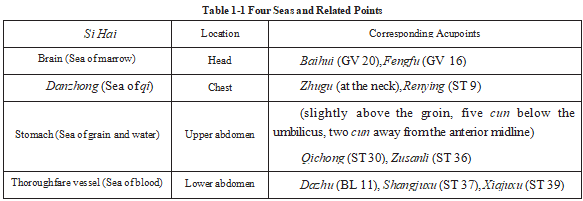
Si Hai (Four Seas) is the place where the water from rivers gathers. In the theory of meridians and collaterals, the place where qi and blood gather is like the sea.
1.3 The Route and Syndrome of the Twelve Channels and the Eight Extraordinary Meridians
1.3.1 Lung Meridian of Hand-Taiyin
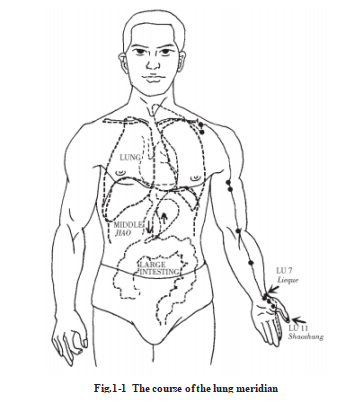
1.3.1.1 The Route of the Lung Meridian Channel (Fig. 1-1)
The lung channel of Hand-Taiyin originates from the middle energizer, descends to connect with the large intestine, returns upwards to pass the upper orifice of the stomach, traverses the diaphragm, and enters the lung, the its pertaining organ. It ascends to the throat region, exits transversely to the armpit from the lung system, then descends along the radial side of the inner upper arm, going in front of the heart channel of Hand-Shaoyin and pericardium channel of Hand-Jueyin, where it reaches the cubital fossa of the elbow. Then it goes continuously downward along the anterior border of the radius in the medial aspect of the forearm and enters cunkou (the anterior margin of the styloid process of the wrist, where the radial artery is palpated). It then passes through the major thenar eminence to terminate at the radial side of the thumbnail.
A branch of this channel splits from the styloid process of the wrist and runs to the radial side of the tip of the index finger, where it connects to the large intestine channel of Hand-Yangming.
1.3.1.2 Syndrome
Symptoms of the related zang-fu organs and meridians passing through:
(1) Because the meridian belongs to the lung, so it can treat cough, asthma, hemoptysis and sore throat.
(2) Pain of the supraclavicular fossa, the pain of radial aspect of inner arm.
1.3.2 Large Intestine Channel of Hand-Yangming
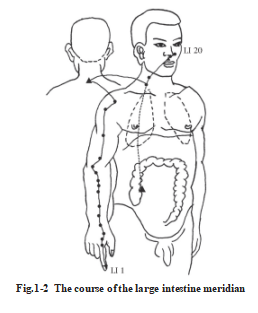
1.3.2.1 The Route of the Large Intestine Channel (Fig. 1-2)
Large intestine channel of Hand-Yangming starts from the tip of the index finger, runs along the radial side of the index finger and passes through the interspace between the first and second metacarpal bones and enters the depression between the two tendons (extensor pollicis longus and brevis), then continues along the anterior aspect of the forearm and enters the lateral side of the elbow. Rising along the lateral aspect of the upper arm to the shoulder joint at Jianyu, it then reaches the governor vessel at 7th cervical vertebra and descends to the supraclavicular fossa in the region of Qupen. It further connects with the lung before descending through the diaphragm to join with the large intestine.
Another branch ascends from the supraclavicular fossa along the lateral aspect of the neck, passes through the cheek, and enters the lower gums. Arising from the gums, it passes through Dicang (ST 4), curves around the upper lip and intersects at the philtrum with the opposite side of the same channel. It finally terminates at the lateral side of the nose.
1.3.2.2 Syndrome
(1) Abdominal pain, borborygmus, diarrhea, constipation, dysentery.
(2) Swollen sore throat, toothache, running nose with cleaning stuff or bleeding.
(3) Symptoms including pain, hot and swelling or cold which appear in the meridian.
1.3.3 Stomach Channel of Foot-Yangming
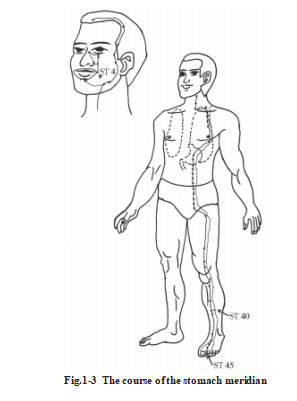
1.3.3.1 The Course of the Stomach Channel (Fig. 1-3)
The stomach channel of Foot-Yangming starts from the lateral side of the nose. It ascends to the medial canthus where it meets the channel of Foot-Taiyang at Jingming (BL 1). Descending from lower margin of eye socket along the lateral side of the nose, it enters the upper gum, circling around the lips, and meets the conception vessel at Chengjiang (CV 24) in the mentolabial groove. Then it traverses the cheeks to Daying (ST 5) and Jiache (ST 6) at the angle of the mandible, ascending in front of the ear, passing through Shangguan (GB 3), following the anterior hairline, it reaches the forehead.
Its cheek branch separates from the front of the Daying (ST 5) and descends through the carotid artery. Passing along the throat, it enters the clavicular pit, further descends and passes the diaphragm, then enters its pertaining organ, the stomach, and meets the spleen and the related organ.
The straight branch of the channel in the chest and abdomen arises from the supraclavicular fossa, descends and passes through the nipple (4 cun lateral to the midline of the chest). It then reaches the lateral side of the umbilicus (2 cun lateral to the anterior midline line of the abdomen) and enters the inguinal region at Qichong (ST 30).
A further branch originates from the lower orifice of the stomach, and descends within the abdomen and joins the previous portion of the channel at Qichong (ST 30). From there,running downward, it reaches the front of the coxa joint, and traverses the quadriceps muscle to the patella. From the patella, it continues descending along the anterior border of the lateral aspect of the tibia to the dorsum of the foot and reaches the lateral side of the tip of the second toe.
The tibial branch of the channel separates from the main channel at Zusanli (ST 36), three cun below the knee and terminates at the lateral aspect of the middle toe. Another branch on the foot emerges from the dorsum of the foot at Chongyang (ST 42) and enters the medial side of the tip of the big toe, where it links with the spleen channel.
1.3.3.2 Syndrome
(1) Stomach pain, abdominal pain, borborygmus, abdominal distension, edema, vomiting, diarrhoea, swift digestion with rapid hunger, thirst.
(2) Toothache, eye disease, sore throat, nasal disease, facial paralysis.
(3) Febrile disease, lunacy.
(4) The diseases of areas where the meridian passes through.
1.3.4 Spleen Channel of Foot-Taiyin
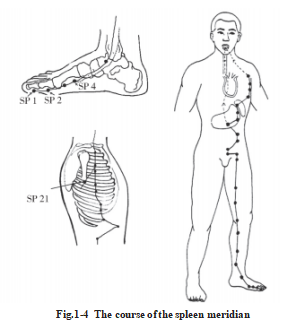
1.3.4.1 The Route or Course of the Spleen Channel (Fig. 1-4)
The spleen channel of Foot-Taiyin originates from the tip of the big toe and runs along the medial aspect of the foot, following the border where the skin changes colour. Ascending to the front of the medial malleolus and running upwards to the medial aspect of the leg, it crosses over and goes in front of the liver channel of Foot- Jueyin, 8 cun superior to the medial malleolus. Ascending along the medial aspect of the knee and the antero- medial aspect of the thigh to the lower abdomen, it reaches the spleen, its pertaining organ, and connects with the stomach. The external pathway of the channel in the abdomen ascends at 4 cun lateral to the anterior midline and it further traverses the diaphragm to the chest at 6 cun lateral to the anterior midline. Running alongside the esophagus, it arrives at the root of the tongue and spreads over the lower surface of the tongue. The abdominal branch of the channel goes from the stomach through the diaphragm and finally flows to the heart to link with the heart channel of Hand-Shaoyin.
1.3.4.2 Syndrome
(1) Stomach, eating with vomiting, belching, abdominal distension, loose stool, jaundice, heavy body and fatigue.
(2) Stiffness and pain in the root of tongue.
(3) The diseases of areas where the meridian passes through.
1.3.5 The Heart Channel of Hand-Shaoyin
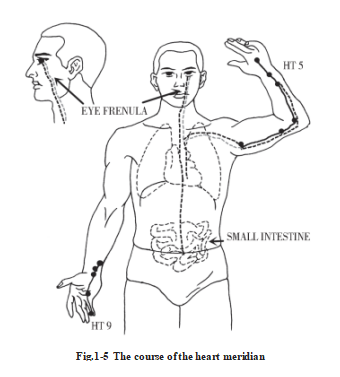
1.3.5.1 The Course of the Heart Channel (Fig. 1-5)
The heart channel of Hand-Shaoyin starts from the heart and pertains to the heart system (the tissues where the heart connects with other organs). It then descends through the diaphragm to connect with the small intestine. Separating from the heart system, a branch passes through esophagus to link with the eye system (the tissues where the eyes link with the brain). The straight portion of the channel from the heart system runs upward toward the lung and descends from the axilla. Travelling along the medial aspect of the upper arm behind the lung and pericardium channels and entering the elbow, it descends along the posterior border of the medial aspect of the forearm to the pisiform bone of the wrist and then it travels through the palm and goes along the radial side of the little finger to its tip, where it links with the small intestine channel of Hand-Taiyang.
1.3.5.2 Syndrome
(1) Heart pain, dry throat, thirst, jaundice.
(2) Heat in the palm.
(3) Lesions in areas where the meridian passes through.
1.3.6 The Small Intestine Channel of Hand-Taiyang
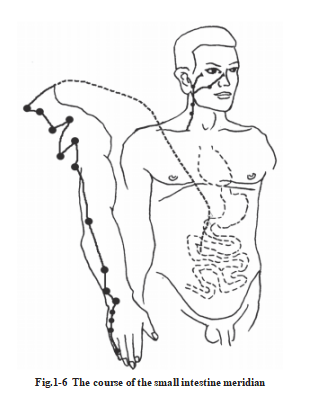
1.3.6.1 The Course of the Small Intestine Channel of Hand-Taiyang (Fig. 1-6)
The small intestine channel of Hand-Taiyang originates from the ulnar side of the tip of the little finger, ascends along the ulnar aspect of the hand to reach the wrist where it emerges at the styloid process of the ulna. It then runs upwards along the posterior border of the lateral aspect of the forearm, and passes between the olecranon of the ulna and medial epicondyle of humerus. Ascending along the posterior border of the lateral aspect of upper arm to the shoulder joint, it proceeds in a zigzag course along the scapular region, intersecting the bladder channel at the top of the shoulder. Then, it reaches the governor vessel. It descends through the supraclavicular fossa and connects with the heart. Descending along the esophagus, it passes through the diaphragm to the stomach and finally enters the small intestine, its pertaining organ. A branch ascends from the supraclavicular fossa to cross the neck and the cheek to the outer canthus of the eye, where it meets the gallbladder channel, then travels posteriorly towards the ear. Another branch separates from the previous branch on the cheek and ascends to the zygomatic bone, then travel along the lateral aspect of the nose to the inner canthus where it meets with the bladder channel of Foot-Taiyang.
1.3.6.2 Syndrome
(1) If the meridian develops abnormal changes, it will lead to the following diseases: sore throat, swollen chin and inability to turn round, the shoulder pain like being pulled, upper arm pain as if it were broken.
(2) The acupoints which belong to this meridian can treat some diseases about “liquid”: deafness, blurred eye and jaundice, swelling cheek, the pain of neck, chin, scapula, pain in the lateral and posterior part of the upper arm and forearm, heat in the palm.
(3) Lesions in areas where the meridian passes through.
1.3.7 The Bladder Channel of Foot-Taiyang
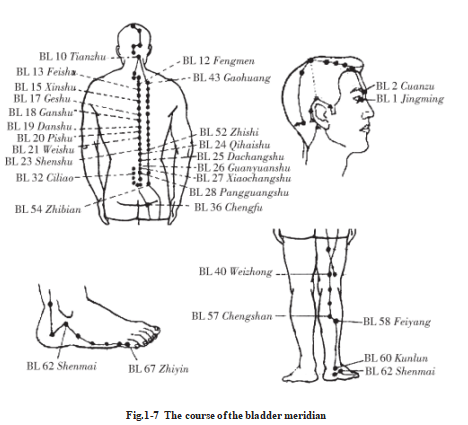
1.3.7.1 The Route of the Bladder Channel (Fig. 1-7)
The bladder channel of Foot-Taiyang begins at the inner canthus of the eye, and then it ascends along the forehead to the vertex. Its branch from the vertex descends to the upper corner of the ear. The straight portion from the vertex enters the brain, then emerges to descend to the nape of the neck where the channel divides into two branches. The first branch descends along the medial aspect of scapular region in parallel with the vertebral column. It then goes to the lumbar region, and next penetrates deep into the interior via the paravertebral muscle to connect with the kidney and link with the bladder.
Another branch separates in the lumbar region, descends along the sacrum, crosses the buttock and descends to the popliteal fossa of the knee.
The branch separates at the nape of the neck and descends along the medial aspect of the scapular region, crosses the hip joint which is in close proximity to the greater trochanter of femur. It then descends along the posterio-lateral aspect of the thigh to meet with the previous branch of the channel in the popliteal fossa. From there, it descends through the gastroc-nemius muscle and emerges posterior to the lateral malleolus. It then follows along the fifth metatarsal bone to end at the lateral side of the tip of the little toe, where it meets with the kidney channel of Foot-Shaoyin.
1.3.7.2 Syndrome
(1) Dysuria, nocturnal enuresis.
(2) Manic-depression, febrile disease, malaria.
(3) Pain of eye, lacrimation induced by irritation of the wind, nasal obstruction and runny nose, epistaxis.
(4) The pain of areas through which the meridian passes.
1.3.8 The kidney Channel of Foot-Shaoyin
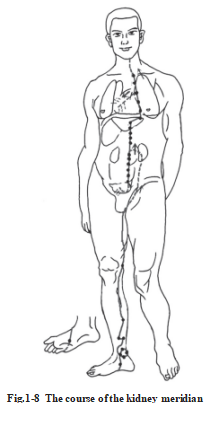
1.3.8.1 The Route of the Kidney Channel (Fig. 1-8)
The kidney channel of Foot-Shaoyin starts from the inferior aspect of the little toe, and runs obliquely towards the center of the sole of the foot, emerging from the lower border of the navicular tuberosity. It travels behind the medial malleolus and enters the heel. It then ascends along the medial aspect of the lower leg and passes the medial side of the popliteal fossa. From the popliteal fossa, it goes upwards along the medial and posterior aspect of the thigh and penetrates through the vertebral column of lumbar region and enters the kidney, its pertaining organ, then links with urinary bladder.
The branch with points emerges from the lower abdomen and traverses the upper abdomen, chest to the lower border of the clavicle.
A straight branch out from the kidney passes through the liver and diaphragm, enters the lung, and then runs alongside the throat, reaching the root of the tongue.
Another branch springs from the lung, links with the heart and disperses into the chest to link with the pericardium channel of Hand-Jueyin.
1.3.8.2 Syndrome
(1) Hemoptysis, asthma.
(2) Dry tongue, swelling and pain in throat.
(3) Edema, constipation, diarrhoea.
(4) Lumbago, disease and pain of areas through which the meridian passes.
1.3.9 The Pericardium Channel of Hand-Jueyin
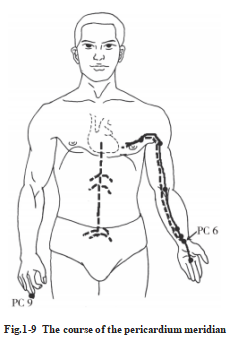
1.3.9.1 The Course of the Pericardium Channel (Fig. 1-9)
The pericardium channel of Hand-Jueyin starts from the chest and belongs to the pericardium. It goes downward passing through the diaphragm to connect with upper, middle, and lower energizers. One branch runs from inside the chest to emerge in the coastal region 3 cun inferior to the anterior axillary fold, and arches over the axilla. It then proceeds along the medial aspect of the upper arm, goes downward between the lung channel of Hand-Taiyin and heart channel of Hand-Shaoyin to enter the cubital fossa. It descends along the forearm between the two tendons of the palmaris longus and flexor carpi radialis muscles to enter the palm, passing along the middle finger to end at its tip.
Another branch arises from the palm at the Laogong (PC 8) and goes along the radial aspect of the ring finger to its tip, where it connects with the triple energizer channel of Hand-Shaoyang.
1.3.9.2 Syndrome
(1) Cardiodynia and chest distress, palpitation, dysphoria.
(2) Manic-depression.
(3) Swollen armpit, spasm and pain in the elbow and arm, heat in the palm.
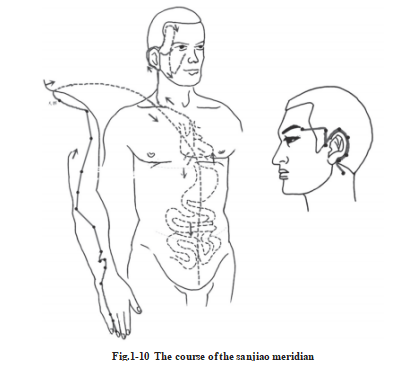
1.3.10 The Triple Energizer Channel of Hand-Shaoyang (Fig. 1-10)
1.3.10.1 The Course or Route of Sanjiao Meridian of Hand-Shaoyang (SJ) or Triple Energizer (TE)
The triple energizer channel of Hand-Shaoyang starts from the tip of the ring finger and goes upward between the 4th and 5th metacarpal bones along the dorsum of the hand. It then emerges between the radius and ulna on the lateral aspect of the forearm, traverses the prominence of the olecranon and continues up the postero-lateral aspect of the upper arm to the shoulder. In the shoulder region, it runs across and passes behind the gallbladder channel of Foot-Shaoyang, winding over to the supracalvicular fossa, and spreading in the chest to connect with the pericardium. It then descends through the diaphragm to the abdomen, and joins its pertaining organ with the upper, middle and lower jiao (energizers).
One branch ascends to emerge from the supraclavicular fossa and rises along the neck to the posterior aspect of the ear. It crosses from the superior aspect of the ear to the corner of the anterior hairline, winding down across the cheek, and terminates in the infraorbital region. Another branch separates behind the ear and enters the ear and re-emerges in front of the ear, crossing the previous branch on the cheek to terminate at outer canthus of the eye, where it connects with the gallbladder channel of Foot-Shaoyang.
1.3.10.2 Syndrome
(1) Abdominal distension and edema, nocturnal enuresis, dysuria.
(2) Deafness, tinnitus, swelling and pain in throat, congested and red eyes, swollen cheek.
(3) Pain in the posterior part of ear and areas of lateral shoulder and arm, elbow.
1.3.11 The Gallbladder Channel of Foot-Shaoyang
1.3.11.1 The Course of the Gallbladder Channel (Fig. 1-11)
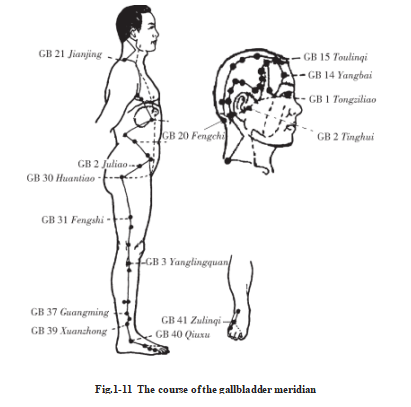
The gallbladder channel of Foot-Shaoyang starts from the outer canthus, ascends to the corner of the forehead, and then curves in a zigzag way to the retroauricular region. Running alongside the neck to the shoulder in front of the triple energizer meridian, it enters the supraclavicular fossa.
One branch emerges from behind the ear and enters the ear, emerging in front of the ear, then reaches to the posterior aspect of the outer canthus.
Another branch starting from the outer canthus runs downwards the Daying (ST 5) and rises to the infraobital regions, running across near Jiache (ST 6) and descending along the neck where it joins the previous branch at the supraclavicular fossa. From there, it further descends into the chest, crosses the diaphragm to connect with the liver and unites with the gallbladder. It continues along the inside of the ribs to emerge in the inguinal region, encircles the genitals, runs superficially along the margin of the pubic hair then enters deeply to emerge at the sacral region where it meets the bladder channel and the governor vessel then emerges on the buttock at Huantiao (GB 30). The straight branch of the channel descends from the supraclavicular fossa to the hip joint at Huantiao (GB 30) to meet the previous branch, passing through the anterior aspect of the axilla, the lateral side of the chest and the free ends of the floating ribs.
It continues down the lateral aspect of the thigh and knee, descends along the lateral aspect of the lower leg to the anterior aspect of the lateral malleolus, follows the dorsal of the foot and ends on the lateral side of the tip of the 4th toe.
The branch from the dorsum of the foot runs between the 1st and 2nd metatarsal bones to the medial tip of the big toe, then passes through the toenail, ending at the hairy region of big toe, where it connects with the liver channel of Foot-Jueyin.
1.3.11.2 Syndrome
(1) Bitter mouth.
(2) Dizziness, malaria.
(3) Lesion in the area where the meridian passes through.
1.3.12 The Liver Channel of Foot-Jueyin
1.3.12.1 The Course of the Liver Channel of Foot-Jueyin (Fig. 1-12)
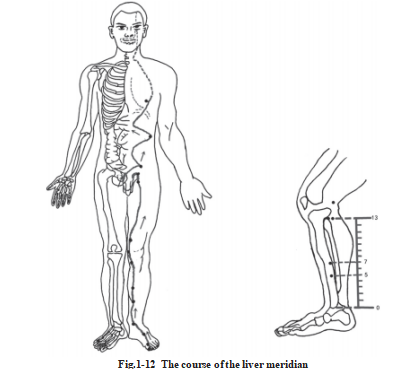
The liver channel of Foot-Jueyin starts from the dorsal hairy of the big toe, it then runs upwards along the dorsum of the foot, 1 cun anterior to the medial malleolus and then travels upwards to the place 8 cun above the medial malleolus, where it crosses and runs behind the spleen channel up to the knee and medial aspect of the thigh, enters the pubic region, where it encircles the genitals, then it goes upwards and enters the lower abdomen, curves around the stomach before entering the liver and connecting with the gallbladder. It then ascends through the diaphragm, spreading in the costaland hypochondriac region. Ascending along the neck and the posterior aspect of the throat to the nasopharynx to link with the tissues surrounding the eye (the “eye system”),it ascends across the forehead to the vertex where it intersects with the governor vessel.
One branch descends from the eye system, and passes through the cheek and encircles the inner surface of the lips.
Another branch splits from the liver, crosses the diaphragm and proceeds upwards to converge in the lung, meeting with the lung channel of Hand-Taiyin.
1.3.12.2 Syndrome
(1) Disease of the liver meridian.
(2) Disease of the gallbladder, spleen and stomach, gynopathy, disease of the lower abdomen and external genitalia.
(3) Other diseases in the area where the meridian passes through.
1.3.13 The Governor Vessel or Du Meridian, GV or DU
1.3.13.1 The Course of the Governor Vessel or Du Meridian, GV or DU(Fig. 1-13)
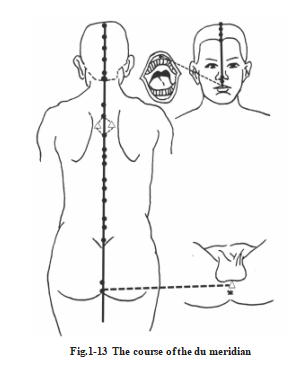
The governor vessel originates from the lower abdomen, descends and goes out of the perineum. It then turns back along the inner aspect of the spinal column, reaching upwards to nape of the neck. From there it enters into the brain and ascends to the vertex. From the vertex, it goes downwards along the forehead to the nose bridge and the philtrum then to the lips, arriving at the junction of the upper lip and gum as terminals.
1.3.13.2 Syndrome
(1) Excess syndrome: spinal stiffness and pain, opisthotonos etc.
(2) Deficient syndrome: the deficient symptoms of the du meridian, such as dizziness, swing and instability. (If nutrition of the brain is insufficient, it will lead to vertigo and tinnitus.)
1.3.14 The Conception Vessel or Ren Meridian (CV or RN).
1.3.14.1 The Course of the Conception Vessel or Ren Meridian (CV or RN) (Fig. 1-14)
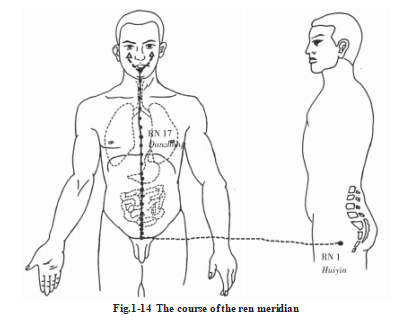
The conception vessel starts from the inside of the lower abdomen, descends and goes out of perineum, going forward and upward into the pubic region. It then ascends along the interior of the abdomen, passing through the midline of chest up to the throat, terminating at Chengjiang (CV 24), the interior portion of the channel curves around the mouth, passing through the check and emerging in the infraorbital region.
1.3.14.2 Syndrome
(1) Hernia of man.
(2) Leukorrhea with reddish discharge of women and abdominal mass.
1.3.15 The Thoroughfare Vessel
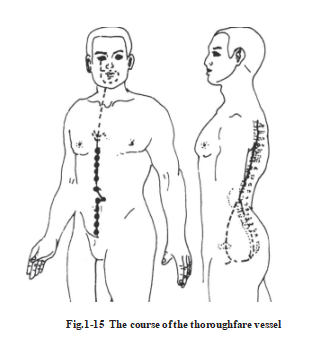
1.3.15.1 The Course of the the Thoroughfare Vessel (Fig. 1-15)
The thoroughfare vessel starts from the inside of the lower abdomen, descends and goes out of the perineum. Then it goes upward along the inside of the spinal column where its superficial branch passes through the region of Qichong (inguinal femoral artery) and communicates with the kidney channel. It then travels along both sides of the abdomen and chest, going up to the throat then to the face and curves around lips.
1.3.15.2 Syndrome
Menstrual disorder, infertility, other gynecological illnesses and inverse abdominal qi uprushing and so on.
1.3.16 The Belt Vessel
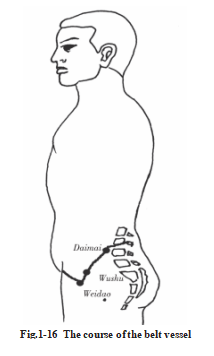
1.3.16.1 The Course of the Belt Vessel (Fig. 1-16)
The belt vessel starts below the hypochondriac region and runs obliquely downward through Daimai (GB 26) then running transversely around the waist and abdomen like a belt.
1.3.16.2 Syndrome
Flaccidity syndrome, irregular menstruation, leukorrhea with reddish discharge and other gynecological diseases.
1.3.17 The Yin Heel Vessel
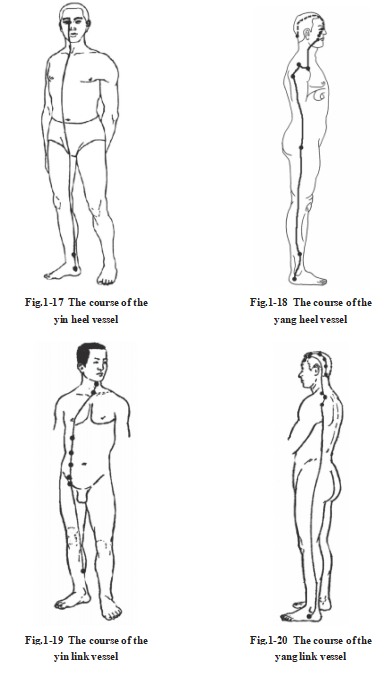
1.3.17.1 The Course of the Yin Heel Vessel (Fig. 1-17)
The yin heel vessel starts from Zhaohai (KI 6) which is under the foot medial malleolus, ascending to the external genitalia through medial malleolus, the postero-medial surface of the lower leg and thigh. It then runs upward along the abdomen and chest to Quepen (supraclavicular fossa), ascending through the throat and emerging anterior to Renying (ST 9). Next it runs upwards beside the mouth and nose to the inner canthus where it meets with the yang heel vessel and the bladder channel at Jingming (BL 1).
1.3.17.2 Syndrome
Profuse sleeping, retention of urine, and the imbalance of limb meridians, the for example, atony of the lateral meridian muscle and spasm of the medial meridian muscle.
1.3.18 The Yang Heel Vessel
1.3.18.1 The Course of the Yang Heel Vessel (Fig. 1-18)
The yang heel vessel starts from Shenmai (BL 62) under the foot lateral malleolus, and travels along the lateral malleolus, the posterior border of the fibula, the lateral thigh, the ventral part, the posterior side of the hypochondrium, and the posterior axillary fold to shoulder. Then, it ascends along the neck to the corner of the mouth and goes upwards and enters the inner canthus to communicate with theyin heel vessel. Finally, it runs up along the bladder channel of Foot-Taiyang to the forehead, passes through the top of the head to nape and it meets the gallbladder channel of Foot-Shaoyang at Fengchi (GB 20).
1.3.18.2 Syndrome
Insomnia and the imbalance of limb meridians, for example, atony of the medial meridian muscle and spasm of the lateral meridian muscle.
1.3.19 The Yin Link Vessel
1.3.19.1 The Course of the Yin Link Vessel (Fig. 1-19)
Theyin link vessel starts at Zhubin (K 9) of the medial shank, ascends along the medial side of the leg and thigh to the abdomen, where it meets with the spleen meridian of Foot-Taiyin, then runs along the chest to neck, where it meets with the ren meridian at Lianquan (RN 23) and Tiantu (RN 22).
1.3.19.2 Syndrome
Cardiodynia, melancholy, stomachache, pain of the chest and the abdomen.
1.3.20 The Yang Link Vessel
1.3.20.1 The Course of the Yang Link Vessel (Fig. 1-20)
The yang link vessel starts at Jinmen (BL 63) and runs upwards along the external malleolus. Ascending along the lateral aspect of the leg and the gallbladder channel of the lateral thigh, it passes through hip joint, ventral part, lateral chest, and posterior aspect of the axilla to the shoulder. Ascending along the neck and jaw, it passes anterior to the ear, and to the forehead, then passes backwards to the vertex of the head and meets with the du meridian at Fengfu (GV 16), Yamen (GV 15) in the end.
1.3.20.2 Syndrome
Aversion to cold, fever and lumbago etc.